Tuesday, August 2, 2016

Traffic-solving Pinoy innovation adopted in 136 cities, except Phl

First of three parts
IT is ironic but true: There are now over 136 cities in 39 major countries worldwide that have adopted a traffic-solving transport innovation started by a Filipino inventor, which caught the World Bank’s attention and got adopted by the US and the world over, but treated with disdain, lamentably, in the Philippines.
Not wrong to copy, but don’t copy wrongly? Innovator Francis R. Yuseco Jr., a onetime investment banker, registered his intellectual-property rights (IPR) 27 years ago in 1989, or 10 years before the popular bus rapid transit (BRT) was adopted abroad.
For Yuseco, getting copied is okay, provided it redounds to the common good, but what matters most is being ignored locally. In the free market of ideas, one can’t demand consideration for originality, as any modification in design, or even change in name, is considered, at times, an innovation and, thus, tolerated.
Lamentably, if they have copied, they should have, at least, done
it grammatically. His system PhilTrak rapid transit (PRT), a proposal of his company PhilTrak, was renamed BRT “Rapid,” describing the bus transit, thus, it should have read “rapid bus transit” to be grammatically correct. But because the Americans called it so, everyone swallowed it without question.
With improvements, Yuseco now calls it Intel-Track, for Philippines Integrated Intelligent Trackways. Perhaps, it’s best to correct its nomenclature to its generic descriptive acronym as RBT, for rapid bus transit.
Faster, cheaper and bigger impact
WHATEVER the name, Yuseco said his is much cheaper by a fraction of the costs of railway, which requires massive construction of pillars, railroad tracks, costly train coaches and power systems, which entail huge investment costs, and five years to build.
But Yuseco’s Intel-Track “can be completed in six months to eight months, or one year, at most to allow delays, because all it takes are designated road tracks. “
Unlike railways, which are subsidized and imported, Intel-Track is subsidy-free. In fact, this is why many countries have shifted to RBT from Metro Rail Transit (MRT)/Light Rail Transit (LRT).
While railways are dependent on foreign technology, foreign imports, foreign loans, foreign consultants and everything foreign, Yuseco’s RBT involves local innovation, local design, local engineers, local investors and local funding. Except for engines of buses, road tracks can be built by local contractors using local materials, thus, generating local employment.
The “ticketing system” and bodies of the buses can also be done locally. With high local content and huge dollar savings, expect higher economic multiplier effects.
Studies, experts validate Yuseco’s idea
AS early as August 1989, the National Center for Transport Studies (NCTS) at the University of the Philippines declared Yuseco’s RBT of only 92 articulated (elongated) buses, carrying 200 passengers each, mostly standing, except for the elderly, pregnant, etc., similar to LRT/MRT, can match the volume of passengers carried by LRT, or the volume of 6,000 regular buses.
They can transport about 1,054,000 passengers daily. The study by the NCTS, then called the UP Transport Training Center (UPTTC), was corroborated by the Department of Transportation and Communications (DOTC), the Department of Public Works and Highways (DPWH) and the Metropolitan Manila Development Authority (MMDA), with all agreeing RBT has the same operating efficiency and capacity of railways, and has an “amazing decongestion factor of 96.8 percent.”
These buses are 18-meters long and 2.7-meters wide, and if necessary design, even much longer buses. If Singapore has buses with passengers standing, except for the elderly, pregnant and the disabled, these buses must also allow mostly standing.
Rejected by all, except then-President Fidel V. Ramos (FVR). Except for Ramos, all past administrations rejected Yuseco’s proposal. Even former President Benigno S. Aquino III’s administration wanted railways, but could neither fix MRT. It even told Yuseco his proposal is allegedly “merely theoretical, unproven and has limited systems capacity.”
Under FVR and eight months of study, it was recommended that pilot tests be done along Commonwealth Avenue and C-5. By October 15, 1997, the Ramos administration made a historic move to award the first RBT project of its kind in the world. Signatories were the late Transportation Secretary Arturo T. Enrile, Public Works Secretary Gregorio Vigilar and MMDA Chairman Prospero Oreta.
But when Enrile died, his successor, Josefina Lichauco, had it reviewed, but approved it anyway. To waive a public bidding, what were invoked was a constitutional provision favoring local inventors; Republic Act (RA) 7459, providing incentives to Filipino investors, and RA 8293, respecting intellectural- property rights.
Gains WB, world attention
YUSECO shows “two vital documents proving indisputably that it gained more attention abroad and that it is Filipinos—the inventor, engineers and academe—who are the originators of the global phenomenon [BRT].”
One is the World Bank Internal Memorandum dated April10, 1990, written by World Bank transport expert Gerhard Menckhoff, who met and praised Yuseco for “the vision, features and operating characteristics of the Filipino invention” and recommended it as “the appropriate mass-transit system for developing and developed economies.” He disseminated it to all World Bank officials worldwide.
The other is a letter from American Bus Association (ABA) President Georg Wynn on August 31, 1999, citing US Federal Transit Administrator Gordon Linton declaration to “reinvent bus service in the US, with the features and characteristics identical” to Yuseco’s PRT, but baptizing it with the catchy but grammatically wrong BRT.
When interests interfered? After getting reviewed and approved twice, Yuseco’s project suddenly screeched to a halt, after the Development Bank of the Philippines (DBP), under the next administration, suddenly demanded P1 billion in hard real-estate collaterals.
One can only surmise or hazard a guess of interests interfering. And yet, DBP took bigger risks bankrolling a lease financing for shopping lines, by purchasing the ships and leasing them to industry.
It is ironic why a project with great impact is not funded, even by phases, and yet, four foreign investors even get power subsidies of P5.86 billion for 2016 alone as provided under Executive Order 666, a number which sounds unholy to Christians.
Public transport’s interests must also be managed well and told they will not be threatened much because when motorists leave their cars, traffic will ease up, and create a huge demand for public transport along arterial roads feeding into the Intel-Tracks. This is crucial because many good plans are blocked when marginalized transport groups oppose, although the government must carry the higher interests of the bigger riding public.
Offtrack maybe, but on-track to the end. Yuseco’s project may have gone offtrack temporarily for almost 30 years, but he hasn’t given up his advocacy, a passion he has developed as early as his first job when he worked with Pantranco North Express. Although he later became an investment banker with companies like Bancom Development Bank, and much later as a partner and executive director of the Philippine Investments Systems Organization, he continued to pursue his passion in transportation.
And to quote Les Miserables French writer Victor Hugo, “Nothing can stop an idea whose time has come.” Yuseco should also realize that the government, in the end, can be reasonable, if he is able to reason.
To be continued
source:  Business Mirror

Monday, August 1, 2016

The partnership in PPP

The rather ambitious infrastructure rollout goals of the Duterte administration will hardly be possible without investments from the private sector. Even the very bullish Budget Secretary Ben Diokno realizes his dream of a Golden Age of Infrastructure requires a very vigorous implementation of the PPP program.
Officials of the past administration couldn’t make up their minds what it wanted to do with PPP. They launched the PPP program in a very grand manner during the first month of the Aquino watch. But the roll out of projects quickly slowed down. Press release lang pala!
The first PPP Center head resigned a few months after the big launch, frustrated with the response he was getting from senior bureaucrats, including cabinet members. His successor, Cosette Canilao, an experienced investment banker, bravely fought her battles but also ended up frustrated enough to quit a few months before the end of the Aquino watch.
Many in the private sector who took official pronouncements at face value soon found the going very rough in their effort to bag PPP projects. In a conference of the construction industry the other week, they commonly complained government bureaucrats forgot the “partnership” in the public-private partnership concept.
One complaint aired: “there is a mindset to control the private sector’s actions, which actually assumes bad faith, in spite of the fact the private sector is putting up all the money and so far, the winning bidders for PPP projects have been the most reputable firms in the country. The government is not treating the private sector as a partner and, in the process, it is unnecessarily complicating the concession agreements.”
Thus, there is this tendency of bureaucrats to enumerate in the concession agreement all the activities that the private sector is obligated to do, the procedures that should be followed and impose corresponding penal provisions. This results “in tedious and convoluted agreements that, at times, border on the ridiculous.”
Business ( Article MRec ), pagematch: 1, sectionmatch: 1
Example cited: “enumeration of 35 events of default for the concessionaire, including when certain reports are delayed. There is also a list of 25 performance standards for operations and maintenance, with penal provisions of up to tens of thousands of pesos, including when there are more than four accidents in a week.”
A reactor in the conference observed “the problem is, the government is treating PPP projects as ordinary government-funded projects and is applying the same tedious rules, even if it is the private sector that is providing the funds. PPP concessionaires are treated as if they are contractors, but they are actually partners with whom government shares many common objectives.”
Bureaucrats, it was suggested, should draft contracts based on fairness and balance. It will result in simpler negotiations. Government should maintain complete transparency in dealing with all bidders rather than wasting time on protracted one-on-one meetings with bidders simply because bureaucrats do not want the bidders to know the objections raised by other bidders.
It is also not fair, a contractor pointed out, to ask the private sector to bid for a project, to win the bid and then be required to still seek some form of operational permit or franchise from regulators. The regulator should be involved in the bidding process so that when the winning bidder signs the agreement, the regulatory permit is also granted as part of the agreement or as a separate document signed at the same time.
The point was raised that the average time from publication of bid notice to award is 29 months and there is a target to reduce this to 20 months, which is still too long. It was recalled the privatization of MWSS was one of the biggest and most complicated in the entire world, but took only 10 months from bid notice to award. It was also hailed as one of the most transparent.
The proposed amendments to the PPP Law should make the program more responsive to problems we now know through actual experience. Some suggested revisions I heard in my conversations with the industry include:
If a project is considered of national significance to qualify for PPP, there should be automatic approval of national and local permits conditioned on submission of relevant documents. This will supposedly cut three to four steps from things proponents have to do after award. Cutting red tape will facilitate executing and delivering the projects.
If already approved by the NEDA Board, the boards of attached agencies should have no more power to pose any opposition in the bidding and implementation of projects. Right now, it was observed that the boards of MWSS, LRTA and PPA among others are opposing biddings of already approved projects.
What’s not in the current PPP Law, but could be a game changer in the execution and delivery of projects, is to provide for only one government agency to do procurements for PPP projects and will only hand over the project to implementing agencies once construction and commissioning are done.
The Procurement Bids and Awards Committee for the projects will be composed of the involved agencies and chaired by the PPP Center and co-chaired by the implementing agency. This should help respond to the problems often blamed on the Procurement Act.
Bureaucrats often forget that the private sector is spending millions of dollars just in the preparation of the bid offers. Indeed, government should be more careful in the choice of technical and engineering consultants.
Experience showed the quality of consultants hired by government has been subpar. They often make serious technical errors that have material financial implications. When this happens, the whole process is delayed because each bidder has to conduct a duplicate technical due diligence instead of having the government consultant do it once.  
Congress is considering a revision to the PPP Law. Sen. Win Gatchalian is proposing a super PPP Center and it looks like the senator is right on track. Of course, the entrenched bureaucrats in NEDA and the various implementing agencies do not like losing turf.
But giving the PPP Center more power is unavoidable if we want to drum up more interest in PPP and realize that Golden Age of Infrastructure the Duterte administration is dreaming of. Bureaucrats who benefit from ODA and direct budget funded infra projects must be made to see the light in the interest of the nation.
The key thing to remember is the word PARTNERSHIP in the PPP concept.
Boo Chanco’s e-mail address is bchanco@gmail.com. Follow him on Twitter @boochanco
 (The Philippine Star) 

Friday, July 29, 2016

Duterte fiscal plan raises red flags

Infra pump priming, 24/7 construction, unsolicited proposals 

MANILA, Philippines - The new administration’s fiscal plan, which entails an aggressive infrastructure spending, around the clock public construction, unsolicited project proposals and presidential emergency powers underscores President Duterte’s resolve to hit the ground running early in his term.
Observers hailed the apparent fiscal pump priming after six years of “cautious” spending program under the administration of former president Benigno Aquino III. Yet this early, red flags are already being raised.
“Their methods mark an innovation, but a little bit complex,” said Emilio Neri Jr., lead economist at Bank of the Philippine Islands.
For her part, Rosario Manasan, research fellow at the Philippine Institute for Development Studies, said “it will all be a matter of projects to be prioritized,” while contractor Ibarra Paulino said execution will be “crucial.”
From here, they listed three vital challenges facing Duterte’s fiscal plan.

Absorptive capacity

Topping the list is government agencies’ absorptive capacity. Manasan said this pertains to the capability of agencies to utilize funds through the completion of projects such that their budgets are consumed by the end of each year.
Business ( Article MRec ), pagematch: 1, sectionmatch: 1
Such was not the case, however, since 1992, data from the Department of Budget and Management showed. Since then, allocations were not completely used and that deficits are more a result of low revenues than high spending.
“Agencies are being choked with funds. They are not used to having so much money to spend,” Manasan said.
This could hit even President Duterte’s plan to get emergency powers from Congress to address what is already deemed a traffic crisis in Metro Manila.
Former president and now Pampanga Rep. Gloria Arroyo is set to file a bill that would grant Duterte additional powers to deal with the deteriorating traffic situation in Metro Manila.
Under her proposal, the President may enter into negotiated contracts for the construction, repair, rehabilitation, improvement or maintenance of critical infrastructure, projects and facilities, subject to certain conditions.
“That will help, but as far as public spending is concerned, the bottleneck is not really in the procurement side but on the agencies,” Manasan said in a phone interview.
“You can increase the budget as much as you want, but if agencies cannot absorb it or spend it because projects are not ready, it will be useless,” she said.
Neri had a different concern. He said while fasttracking spending is always welcome, this should not come at the expense of misusing public funds.
He echoed Melissa Yan, deputy executive director of the Government Procurement Policy Board, who earlier said the procurement laws, no matter how tedious, are created as “an anti-corruption measure.”
“If special powers are used to the extent of resorting to bending the rules, that’s a sign of wanting to take short cuts and that’s not good,” Neri said separately.
Finance Secretary Carlos Dominguez, however assured: “We will make sure that projects will undergo enough scrutiny.”

Revenues

The plan is to widen the budget gap—which indicates government spent more than earned — to three percent of economic output from just 0.9 percent last year.
This will be done through additional funds for infrastructure, programmed to corner at least five percent of gross domestic product (GDP) under Duterte. Last year, it hit a record high of 3.3 percent.
While Budget Secretary Benjamin Diokno said the figure is sustainable, Manasan said it would depend on where the deficit would come from. “What is the context of increased deficit?”
“They have plans to have tax reform and reduce income taxes. It remains to be seen if they can offset that, but I don’t think tweaking VAT exemptions would do it,” Manasan said.
“They should be careful because we might go back to a situation where we lack money,” she added.
So far, details were scarce as to the contents of Duterte’s tax reform. Former Finance secretary Cesar Purisima left Dominguez a tax package that would generate as much as P77 billion in the first year, but the latter said he will not use it.
He would, however, embarked on tax administration measures similar to Purisima’s such as filing of tax evasion and smuggling cases, rationalizing fiscal incentives, relaxing bank secrecy law, and making tax evasion a predicate crime to money laundering.
“The impact would really depend on the timing when these measures are rolled out. If they come in later than lowering income taxes, that could be revenue eroding,” Neri said.
At 14.7 percent of GDP as of the first quarter, the Philippines’ revenues are one of the lowest in Southeast Asia. Considering only taxes, the ratio of 13 percent was also among the worst.
Before this period, revenues and taxes, as a proportion of GDP, underwent a decline since 1997, finance data showed. This contributed to an increase in deficit to five percent in 2002.
“I think their appetite for risks is high would be willing to take a credit downgrade if it means pushing with their programs,” Neri said. Dominguez had long criticized the past administration for focusing too much on credit ratings.
But Alvin Ang, economist at Ateneo de Manila University, believes there should be no problem with it.
“Your economy is liquid and we have not really taken advantage of our investment grade. Besides, I’m sure Dr. Diokno knows what he is doing and will not let that happen,” Ang said by phone.
Diokno, whose first term as budget chief saw the deficit at 3.7 percent of GDP in 2000, only had this to say: “The fear of higher deficit is misplaced.”

Private sector woes

Paulino, executive director of Philippine Constructors Association, said another factor to consider would be the capacity of contractors to cope with the spending push.
While he welcomed plans to undertake a non-stop, 24 hours contruction of major infrastructure projects initially in Metro Manila, Paulino said there might not be enough willing contractors in the provinces, particularly Mindanao.
“There are not much qualified contractors who would want to go to Mindanao because of the peace and order situation there. Most of them are here (in Manila) and Cebu,” he said by phone.
Cosette Canilao, former executive director of Public-Private Partnership (PPP) Center, meanwhile said projects should also be scrutinized carefully, especially those coming from the private sector.
Unsolicited PPPs -- such as the Metro Rail Transit 3 and Ninoy Aquino International Airport Terminal 3 -- are so prone to corruption that the government should hire good consultants to evaluate them as well as improve Swiss challenges.
“The challenge process should be clear. The challenge period should also be increased, but that can only be done via amendment of the BOT (build-operate-transfer) law,” Canilao said in an e-mail.
But Neri said this would seem have to wait for a while.
“What (Duterte administration) is doing is contrary to institutional reforms. We have not seen that yet,” he said.
“I think they are trying to put out fires first. Focus on very urgent matters that need attention. Hopefully after, they would go on long-term reform, which is much more important,” he added.
SOURCE:  The Philippine Star

Tuesday, July 26, 2016

If Trump Wins, Asia Loses

South Korea, Philippines are most at risk in Asia if trade barriers rise


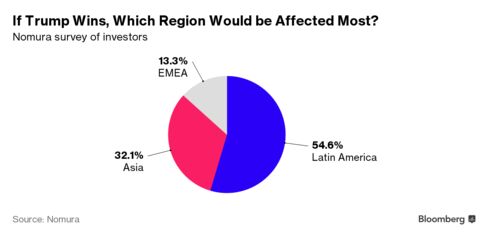
Investors say there's a low chance Donald Trump will build a wall on the U.S. border with Mexico if he becomes president. But they think it’s highly likely he'll slap tariffs on Asian imports, triggering a currency war. 
An investor survey conducted earlier this month by Nomura Holdings Inc. flags a long list of worries under a Trump presidency: from a possible rise in trade protectionism to threats to regional security if the U.S. cuts its military commitments in Asia.
The conclusion is clear: after Mexico, Asia is most at risk.
"A Trump presidency would no doubt hurt Asia’s gross domestic product growth and could ultimately drive cost-push inflation, impart smaller trade surpluses and looser macroeconomic policies," said Rob Subbaraman, the report’s lead author.
In Nomura's report, titled "Trumping Asia", 77 percent of respondents in its survey expect the U.S. will brand China a currency manipulator under Trump and 75 percent predict he will impose tariffs on exports from China, South Korea and Japan. Only 37 percent think he will follow through with a pledge to build a wall along the Mexican border. 
Nomura didn't disclose how many respondents it surveyed. 
Investors' fears aren't unwarranted. Asia is the world’s manufacturing hub and many nations are export-dependent, putting them at risk if trade barriers start rising.
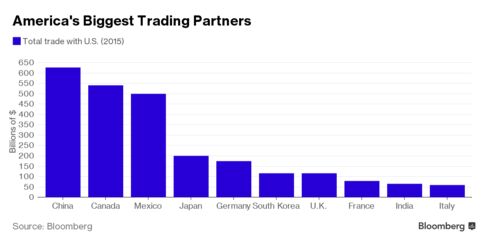
China was the U.S.’s biggest trading partner last year, and if trade restrictions are imposed on the nation, the knock-on effects on the rest of Asia would be substantial, according to Nomura.
None are more vulnerable in Asia than South Korea and the Philippines. South Korea faces a possible backlash from two sides: Trump has criticized a 2012 free-trade agreement with the country, saying it has destroyed almost 100,000 American jobs; and he has vowed to force South Korea to meet the full cost of security guarantees provided by the U.S., which may add to fiscal woes there, Nomura said.
The Philippines faces risks because of possible immigration restrictions. The U.S. is host to 35 percent of the total number of Filipinos working abroad, and Nomura estimates they account for about 31 percent of total worker remittances, a key source of foreign inflows for the local economy.
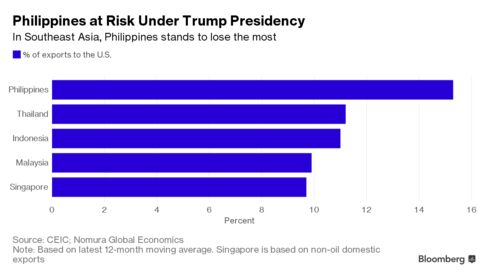
The Philippines has one of the biggest export exposures to the U.S. in Southeast Asia and Trump’s pledge to bring jobs back to the U.S. may threaten the nation’s burgeoning business process outsourcing sector. The industry caters mostly to U.S. companies and attracts revenue that may equal the size of total worker remittances, about 9 percent of GDP, over the next two years, according to Nomura.
Nomura's analysis finds the least vulnerable economies include India and Thailand.
While the majority of respondents in the Nomura survey view a Trump victory as unlikely, the threat of protectionism is real. 
Trump has already pledged to withdraw the U.S. from the Trans-Pacific Partnership -- a free-trade agreement covering 12 countries from Peru to Malaysia and that accounts for 40 percent of the global economy. If TPP is ratified before President Barack Obama leaves office, Trump still has the authority to withdraw the U.S. from the treaty.
Under U.S. law, the president can impose punitive duties, including a 15 percent tariff for a maximum of 150 days without prior Congressional approval in the case where the U.S. has a “large and serious” balance of payments deficit with another nation, such as China.
If China is declared a currency manipulator -- a power that resides with the U.S. Treasury without needing the approval of Congress -- it could trigger a range of trade restrictions too. Under these conditions of rising trade barriers and reduced foreign investment, Chinese policy makers may seek to weaken the yuan at a faster rate,  according to Nomura.
Trump could well change his policy views in the run-up to the November election and Asian officials are bracing themselves for inconsistent messages until then.
“We are all discovering Donald Trump, as he is himself: there is a stream of consciousness approach to policy pronouncements,” Singapore’s Deputy Prime Minister Tharman Shanmugaratnam said in April. “One can only hope that it evolves towards addressing the strategic interests of the United States in the world.”
source:  Bloomberg

Friday, July 8, 2016

Infra bond offerings beyond PPP eyed

OFFERINGS in the country’s capital markets should cover infrastructure projects beyond those under the public-private partnership (PPP) scheme, according to a regulator and a top financial sector executive.

Securities and Exchange Commission (SEC) Chairperson Teresita J. Herbosa and BDO Capital Investment Corp. President Eduardo V. Francisco separately floated the possibility of “project bonds” in addition to allowing companies with PPP infrastructure contracts to join the Philippine Stock Exchange (PSE).

“In addition to what you would call PPP bond issuances, we’re also thinking of project bonds... we’re conducting a study on that,” Ms. Herbosa told BusinessWorld after the ceremonial listing of P10 billion worth of bonds issued by Ayala Corp. on the Philippine Dealing & Exchange (PDEx) in Makati City on Thursday.

Mr. Francisco, meanwhile, noted that discussions with the PSE included the possibility of expanding the coverage of the listing framework to include companies implementing public infrastructure projects outside the PPP program.

“The thing I’m suggesting is they include other infrastructure [projects] so that if, let’s say the project is not considered a PPP because it was unsolicited, it’s still covered,” Mr. Francisco told reporters in a mix of English and Filipino.

The SEC, along with other organizations, will look into the feasibility of allowing the issue of project bonds by companies engaged in infrastructure developments whether under a PPP contract or not, Ms. Herbosa said.

“Advisers from Treasury of the US and FINEX (Financial Executives Institute of the Philippines) headed by Mr. Francisco as well as PDEx headed by (Chairman and Chief Executive Officer) Mr. (Cesar B.) Crisol would form a committee together with our people to study project bonds or PPP bonds,” Ms. Herbosa said.

In end-May, the PSE released the proposed supplemental listing and disclosure rules applicable to entities undertaking PPP infrastructure projects to solicit feedback from stakeholders.

According to the draft rules, a company or group working on an infrastructure project under a PPP contract worth at least P5 billion can join the stock exchange.

It must have commenced commercial operations or completed construction or a phase at the time of listing.

In addition, the PPP contract of the company or group must have a minimum remaining life of 15 years from the date it filed a listing application.

PSE Chief Operating Officer Roel A. Refran, in an earlier interview, cited that the minimum 15-year remaining life requirement for PPP contracts of interested entities as the “major point” of discussions in public comments.

“That should not be a problem because infrastructure, especially when their implemented under PPP contracts, last 20-30 years, so it’s more on the [inclusion of] other projects,” Mr. Francisco said when asked for comment.

Mr. Francisco also noted that private-sector proponents of PPP projects would rather tap banks for pre-funding requirements rather than the capital markets.

“When you win the PPP, you have 12 months to close. Time-wise, procedure-wise, I don’t think it will work. So, what the PSE did was to open the market when the concerned entities are simply de-risking or close to completing the project,” Mr. Francisco said.

“That will work perfectly for the bank. Sometimes, we lend to these consortium, say for the first four years of construction, and once operational, they can refinance. So, if the PPP comes out with a [better] alternative, they can in turn pay off the banks.”

The administration of President Benigno S.C. Aquino III put together 53 projects in the PPP pipeline. Of these, 12 cumulatively worth P217.4 billion were awarded, although the P5.61-billion Philippine Orthopedic Center modernization contract was rescinded in November last year. The pipeline also includes 15 projects in various stages of procurement, two for rollout, five for government approval and three with ongoing studies.


source:  Businessworld

Sunday, June 26, 2016

The future of PPPs is written on the wall

IS public-private partnership (PPP) the only solution to the infrastructure deficit? Is PPP truly a priority program of the incoming Duterte administration? What is its relevance and importance in achieving the 10-point socioeconomic agenda? Is there a future for the PPPCenter? What could be the role of the PPP Center moving forward?
From all indications, PPP will be a priority program and a key change strategy of the incoming administration. Recent events will show that President-elect Rodrigo R. Duterte is not just paying lip service.
In the recently concluded two-day business summit in Davao City, the 10-point socioeconomic agenda of the incoming administration was presented and discussed. The fourth agenda includes PPPs. The President has committed to “accelerate annual infrastructure spending to account for 5 percent of the gross domestic product, with PPP playing a key role.” At the sidelines of the event, incumbent City Mayor Duterte signed a 50-year joint-venture agreement with the private sector, selected through the unsolicited proposal route, for the Davao Coastline and Port Development Project worth close to
P39 billion.
Here are five suggested actions points on the fourth agenda:
1.  From PPP to PPPP. The current tag of this program only highlights the parties (i.e., public and private) and the relationship between them (i.e., partnership). The purpose or “true north” of the arrangement is, however, deemphasized. It must be underscored that any PPP should be for better, not just good, quality of life. PPP may, therefore, be rebranded as PPPP or PPP for the People.
 2.  PPP is a part of a whole. PPP cannot be the end in itself. It is should not even be viewed as a panacea or the only solution to the infrastructure and public-services deficit. As discussed in the two-day summit, “PPPs are not a quick fix for financing and delivery, but can be an important part of infrastructure delivery.” It must be pursued as a program and a change strategy.
3.  Expanding the PPP definition and reach. To be an effective change strategy, adaptive innovation must be encouraged. Alternative PPP modalities should be advanced. Confining PPP to the modalities under the build-operate-transfer law stymies innovation. More options is better.
To facilitate inclusive growth in the whole country, PPPs should be implemented outside Metro Manila and nearby areas. Local governments all over must be empowered and encouraged to adopt their own PPP frameworks.
4.  Strengthening and decentralizing the PPP Center. The need for a central technical and advisory agency on PPPs under the National Economic and Development Authority, or possibly under the Office of the President to underline the priority, cannot be understated.
The PPP Center should continue to be the repository of expertise, data and learning. However, the expertise should not be monopolized under one roof. Horizontal and vertical decentralization must be promoted. Satellite PPP Centers in Northern Luzon, the Visayas and Mindanao may be established. Implementing agencies at all levels—i.e., national, state corporations and local governments—should have their own PPP units. The PPP Center can, thus, serve as institutional mentor and coordinating agency of these units.
 5.  Future-proofing PPPs. Successor risk or changes in policies and interpretations and unilateral amendments or rescission of PPP contracts entered into by previous administrations should be avoided. Stability, trust and participation by stakeholders motivated by the fourth “P” are critical in sustaining PPP. Ethical standards must be in place.
PPPs must promote human rights, climate and gender justice. Citizens’ participatory audit must be institutionalized.
We are looking forward to a brighter and comfortable future. We hope that PPP, among other change strategies, can bring
us there.
source:  Business Mirror
Alberto Agra 2

‘Brexit’ lessons for the Philippines

THE recent referendum vote held in the United Kingdom seems straight forward enough. The ballot had two choices: “Remain a member of the European Union” and “Leave the European Union.” The final result of last Thursday’s voting was 51.9 percent to “Leave” and 48.1 percent to “Remain.”
The outcome was fairly close, but still decisive, with the Leave getting 7.8 percent more votes than Remain. However, those numbers are deceptive.
The vote for Remain won in an absolute landslide victory. The vote for Leave won in an absolute landslide victory. It all depends on where you look.
 The United Kingdom is composed of England, Northern Ireland, Wales and Scotland, through centuries of treaties and to a certain extinct kingly conquest. And like every diverse nation, there are many viewpoints and biases.
In a postmortem of the vote, the Remain-inclined press pointedly mentioned that in an area of England with higher education, Remain was a big winner. London, for example, voted 60 percent to 40 percent in favor of Remain, a landslide. However, London is also home to the financial institutions that have a vested interest in staying part of the EU. Obviously, multinational banks tend to employ higher-educated people. So, of course, London would vote Remain, but not as a result of being “smarter,” but because it was in their financial interests.
The West Midlands region of England voted the opposite way—60 percent for Leave. The city of Birmingham is in the West Midlands and is England’s second-largest city. Birmingham used to be a manufacturing and engineering center. Today, its economy is dominated by the service sector, which in 2012 accounted for 88 percent of the city’s employment. Economic inequality within Birmingham is greater than in any other major English city.
The North East region of England also voted 58 percent for Leave. Thirty percent of the people there consider themselves in the “D” or “E” segment of the UK’s economic classes. England’s eastern area also went heavily—57 percent—for Leave. Here, youth unemployment is 33 percent.
This referendum was about an issue that significantly affected every citizen of the United Kingdom and a critical national policy. Yet, when you look at the results, the voters cast their ballots exactly as people always do: Based on their own personal interest. London bank employees voted for what was best for London banks. Lower-income classes in depressed areas voted for a change from the current situation, which they believe has failed them.
 In a short time, the Philippines will face deciding about some critical issues from the status of Muslim Mindanao, perhaps, a change to a parliamentary or federal form of government to changes in the Constitution regarding foreign ownership of businesses.
Will Filipinos push for a decision that they think will be best for the entire nation or for what will be best for their own personal interests?
source:  Business Mirror